Ancient Cities and the Warden Backstory
The deep dark biome, the sculk network, and the Warden: what the Ancient Cities tell us about a lost civilization that dug too deep.
This page is about the Ancient Cities themselves: how they are laid out, what the sculk has done to them, and what a city with furniture and no inhabitants implies. For the creature that patrols them, what it can hear and why it is not built to be killed, read The Warden: Ancient Guardian of the Deep.
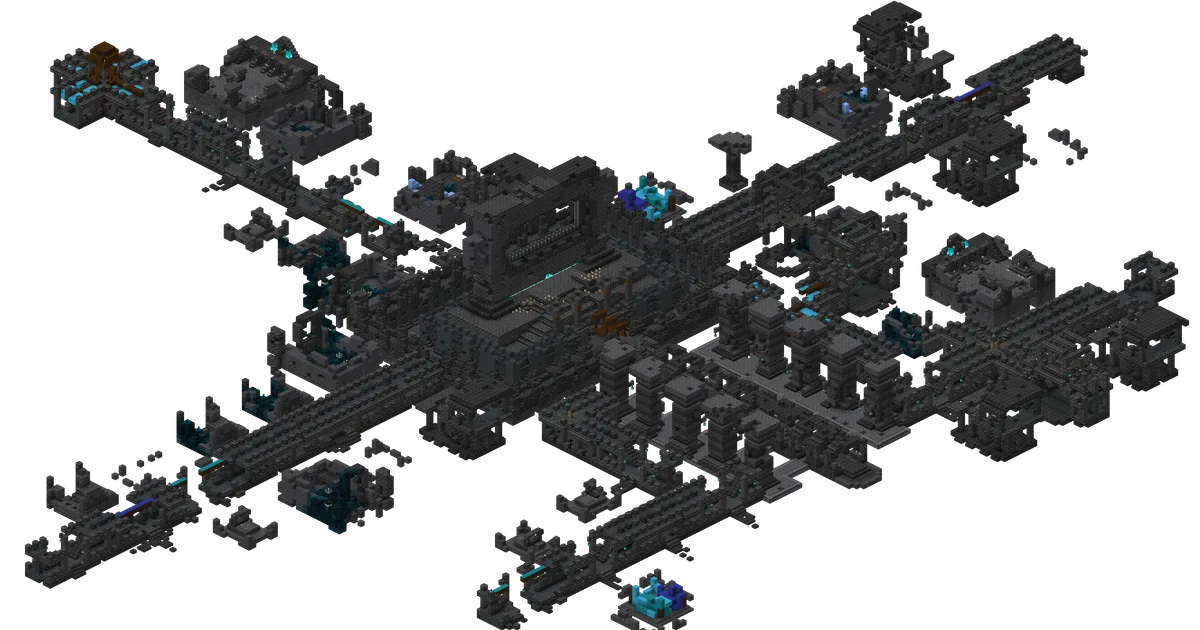
Update 1.19 (The Wild Update) introduced the Deep Dark biome and the Ancient Cities buried within it. These structures sit at the lowest levels of the world, below Y-level 0, surrounded by sculk blocks that spread like an infection. At the center of each city stands a reinforced deepslate frame with no known use. And somewhere in the darkness, the Warden waits.
The Deep Dark Biome
The Deep Dark generates in the deepest caves, far below the surface. It is defined by sculk, a dark blue-green block that spreads when mobs die near a sculk catalyst. The sculk network consists of several block types: sculk itself, sculk veins, sculk catalysts, sculk sensors, and sculk shriekers. Together, they form a detection system. Sensors pick up vibrations. Shriekers call the Warden.
This is not natural cave generation. The sculk behaves like a living organism, growing from death and converting nearby blocks into itself. It feeds on experience orbs dropped by dying mobs, expanding its territory with each kill. The Deep Dark is not a biome. It is a colony.
The Ancient City Layout
Ancient Cities are massive structures, among the largest generated structures in the game. They feature long corridors, wool-lined pathways (wool does not transmit vibrations), and large open spaces. The architecture is unmistakably built by intelligent beings. These were not monster spawners or natural formations. Someone lived here.
Key features include ice box storage rooms, redstone laboratories, and the central portal frame made of reinforced deepslate. The wool on the floors and walls was deliberately placed to allow silent movement, meaning the builders knew about the sculk's vibration detection and were trying to coexist with it, or hide from it.
The Reinforced Deepslate Frame
At the center of every Ancient City sits a structure made from reinforced deepslate, a block that cannot be obtained or broken in survival mode. The frame resembles a portal, with a sculk-covered floor and soul fire lanterns on the corners. But the portal does not activate. There is no known way to open it.
Mojang developers have hinted that this structure may serve a purpose in future updates. For now, it stands as the game's most prominent unsolved mystery. What dimension would it lead to? Why was it sealed? Did the builders close it deliberately, or was it shut by whatever drove them out?
The Warden
The Warden is not a boss. It has no health bar displayed on screen. It cannot be reasonably fought in early or mid-game gear because it deals enormous damage and has 250 hearts of health (500 HP). It is blind, navigating entirely by sound and smell. It emerges from the ground when sculk shriekers are triggered repeatedly, clawing out of the earth like something buried alive.
The Warden's design is deliberate. You are not meant to fight it. You are meant to avoid it. This is the only mob in Minecraft designed around stealth rather than combat. Its existence changes how you interact with the game at these depths: slowly, carefully, silently.
Sculk as a Life Cycle
The sculk catalyst converts dying mobs into more sculk. The sculk sensor detects movement. The sculk shrieker summons the Warden. The Warden kills intruders. Their death feeds the catalyst. The cycle continues. This is not a defense mechanism. It is an ecosystem, a closed loop of death and growth.
The sculk on the Warden's body suggests it is part of this cycle, possibly a creation of the sculk itself. The Warden might not be a creature that chose to live in the Deep Dark. It might be something the sculk grew, an antibody produced by a living network to protect itself from threats.
What Happened to the Builders?
The Ancient Cities are abandoned. The wool pathways are crumbling. The redstone labs are silent. Whoever built these cities is gone. The sculk that coats the walls and floors may be the answer. If the sculk grows from death, and the entire city is covered in it, then a massive number of beings died here. The sculk did not invade the city. The city fed the sculk, one death at a time.
The builders may have tried to harness the sculk's energy or use the portal. They may have dug too deep and encountered something they could not control. The wool pathways suggest they knew the danger and adapted. But in the end, adaptation was not enough.
More in Places and Structures
The pages closest to this one first, including anything from another category that points here, and then the rest of Places and Structures, the category this article belongs to.
Closest to this page
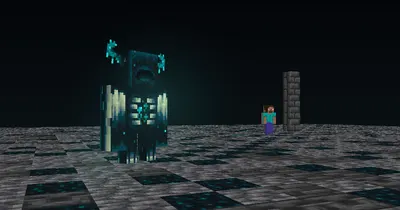
The Warden: Ancient Guardian of the Deep
 The Warden: Ancient Guardian of the Deep
The Warden is blind, deadly, and tied to the sculk network. It is not a boss to be fought but a force of nature to be feared.
5 min read
The Ancient Builders Theory
 The Ancient Builders Theory
The most popular Minecraft theory: a lost civilization built the Strongholds, Temples, and Nether Fortresses before vanishing. Where did they go?
8 min read
Strongholds: Purpose and Origin
 Strongholds: Purpose and Origin
Why do Strongholds exist? Who built them around End Portals, and what were they trying to protect -- or contain?
5 min read
The Meaning Behind Minecraft's Music Discs
 The Meaning Behind Minecraft's Music Discs
Minecraft's music discs tell a hidden story. From the haunting '11' to the mysterious '5', the discs contain clues about the game's deeper lore.
5 min read
Archaeology: Suspicious Sand, Gravel, and Lost History
 Archaeology: Suspicious Sand, Gravel, and Lost History
Minecraft's archaeology system lets you brush away sand and gravel to uncover pottery sherds, armor trims, and relics. Each shard tells a story of the past.
5 min readRest of Places and Structures
Often read alongside
The End Poem: Analysis and Meaning
7 min read The End Poem: Analysis and Meaning
Pillagers and Illagers: A Fallen Civilization
6 min read Pillagers and Illagers: A Fallen Civilization
Piglin Civilization and the Nether's Past
6 min read Piglin Civilization and the Nether's Past
Enderman: Origin and Behavior Lore
6 min read Enderman: Origin and Behavior Lore
Herobrine: Origin, Mojang Responses, and Cultural Impact
6 min read Herobrine: Origin, Mojang Responses, and Cultural Impact
 Steve and Alex: Identity Theories