Trial Chambers and the Breeze
The mysterious Trial Chambers from update 1.21, the wind-based Breeze mob, and the automated challenge system left behind by unknown builders.
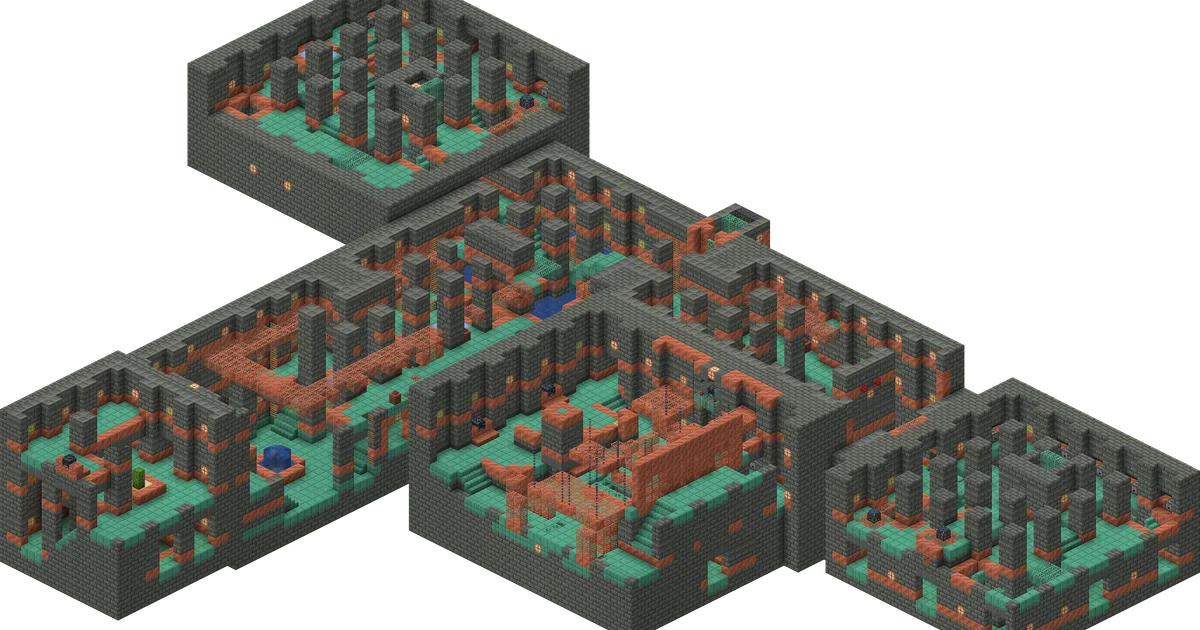
Update 1.21 introduced Trial Chambers, procedurally generated underground structures filled with combat challenges, traps, and a new mob called the Breeze. These structures feel different from anything else in Minecraft. They are not ruins. They are not abandoned cities. They are training facilities, testing grounds designed to evaluate whoever enters them.
Structure and Design
Trial Chambers generate underground, built primarily from copper and tuff blocks. Their hallways are wide, their rooms are varied, and each chamber contains Trial Spawners: special spawner blocks that activate when a player enters the room and produce a fixed number of mobs based on how many players are present. Once all spawned mobs are defeated, the spawner ejects rewards and goes on cooldown.
This scaling difficulty is important. The Trial Spawners are not just spawning random enemies. They are calibrating the challenge to the number of participants. This is automated game design built into the game world. Someone programmed these challenges.
The Breeze
The Breeze is a wind-elemental mob found exclusively in Trial Chambers. It attacks by launching wind charges that deal knockback and can interact with buttons, levers, and trapdoors in the environment. The Breeze does not deal heavy damage directly. Instead, it uses the chamber's terrain against you, knocking you into hazards or off platforms.
The Breeze's design is functional rather than aggressive. It tests your ability to manage positioning and environmental awareness. This reinforces the idea that Trial Chambers are tests, not threats. The Breeze is a training tool, not a monster.
Who Built Them?
The copper and tuff construction of Trial Chambers does not match any other structure in Minecraft. Strongholds use stone brick. Ancient Cities use deepslate. Nether fortresses use nether brick. Trial Chambers have their own architectural language, suggesting a different builder or a different era.
The use of copper is notable because copper oxidizes over time in Minecraft, changing color from orange to green. The Trial Chambers are found in various states of oxidation, implying they have existed for varying lengths of time. Some are ancient. Others seem relatively recent. Were new chambers being built even as older ones aged?
The Vault System
Trial Chambers contain Vault blocks, which can be unlocked with Trial Keys dropped by defeated Trial Spawners. Each Vault can only be opened once per player, preventing farming. The Vaults contain exclusive rewards including the Mace weapon, armor trims, and other unique items.
The one-per-player mechanic is remarkable from a lore perspective. The Vaults know who has opened them. They track individual players. This is a level of magical or technological sophistication that surpasses anything else in the game world.
A Testing Ground for What?
The biggest unanswered question: what were Trial Chambers testing for? If they are training facilities, what were the trainees being prepared to face? The scaling difficulty, the environmental puzzles, the reward system -- all of it points toward a structured program designed to strengthen warriors.
Were the builders preparing fighters for the Ender Dragon? For the Wither? For something worse, something we have not yet encountered? The sealed portal in the Ancient Cities comes to mind. If something terrible waits behind that reinforced deepslate frame, you would want trained warriors ready to face it.
More in Places and Structures
The pages closest to this one first, including anything from another category that points here, and then the rest of Places and Structures, the category this article belongs to.
Closest to this page
Ancient Cities and the Warden Backstory
 Ancient Cities and the Warden Backstory
The deep dark biome, the sculk network, and the Warden: what the Ancient Cities tell us about a lost civilization that dug too deep.
7 min read
Strongholds: Purpose and Origin
 Strongholds: Purpose and Origin
Why do Strongholds exist? Who built them around End Portals, and what were they trying to protect -- or contain?
5 min read
The Ancient Builders Theory
The most popular Minecraft theory: a lost civilization built the Strongholds, Temples, and Nether Fortresses before vanishing. Where did they go?
8 min read
Archaeology: Suspicious Sand, Gravel, and Lost History
 Archaeology: Suspicious Sand, Gravel, and Lost History
Minecraft's archaeology system lets you brush away sand and gravel to uncover pottery sherds, armor trims, and relics. Each shard tells a story of the past.
5 min readOften read alongside
The End Poem: Analysis and Meaning
7 min read The End Poem: Analysis and Meaning
Pillagers and Illagers: A Fallen Civilization
6 min read Pillagers and Illagers: A Fallen Civilization
Piglin Civilization and the Nether's Past
6 min read Piglin Civilization and the Nether's Past
Enderman: Origin and Behavior Lore
6 min read Enderman: Origin and Behavior Lore
Herobrine: Origin, Mojang Responses, and Cultural Impact
6 min read Herobrine: Origin, Mojang Responses, and Cultural Impact
 Steve and Alex: Identity Theories