The End Poem: Analysis and Meaning
A deep dive into the philosophical themes and hidden meaning behind Minecraft's End Poem, the credits sequence that plays after defeating the Ender Dragon.
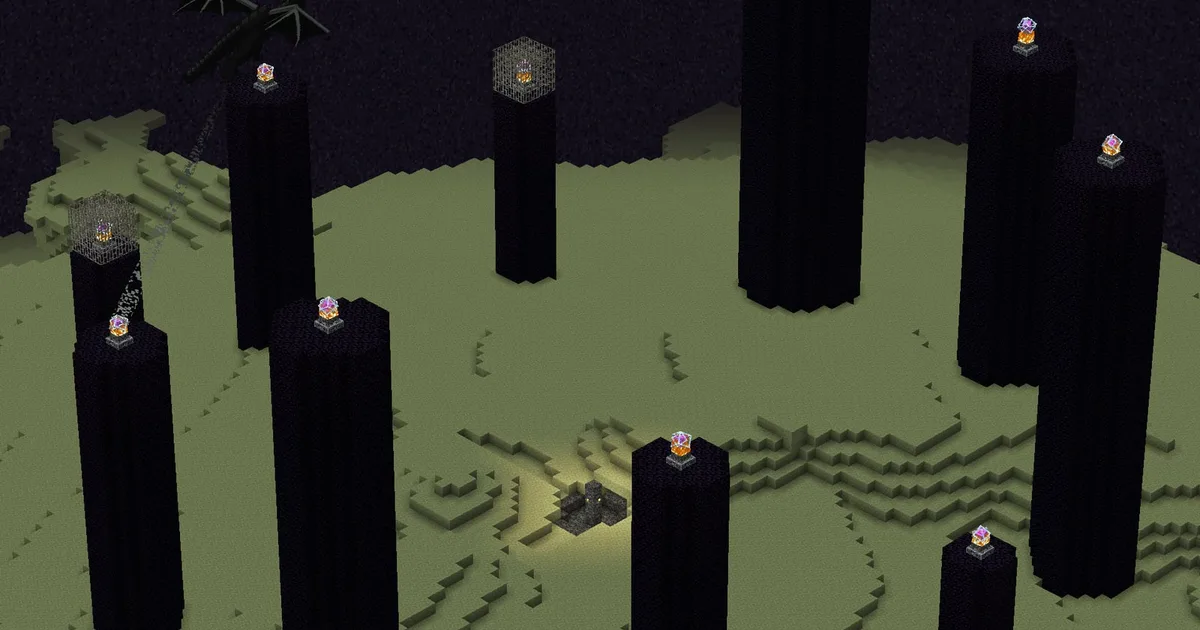
When you step through the exit portal after defeating the Ender Dragon, Minecraft does something no other game quite replicates. Instead of a simple credits roll, you are presented with a conversation between two unnamed entities. This text, commonly called the End Poem, was written by Julian Gough and released into the public domain in 2022. It remains one of the most discussed pieces of writing in gaming history.
The Two Speakers
The End Poem is structured as a dialogue between two voices, rendered in different colors on screen. These speakers are never named. They discuss the player, referring to them in the third person, and they seem to exist outside the game world entirely. Some readers interpret them as gods or cosmic forces. Others see them as the game itself reflecting on the person who played it. Neither interpretation is wrong, because the text deliberately avoids confirming any single reading.
What matters is what they say. The speakers talk about dreams, about the nature of reality, about the thin line between the dreamer and the dream. They address the player's journey through the game not as a series of mechanical achievements but as something genuinely meaningful. The text suggests that the act of playing, building, and surviving in this blocky world carries real weight.
The Universe as a Dream
One of the central themes is the idea that the Minecraft world is a dream, and that the player is both the dreamer and part of the dream. The speakers describe the universe as something that "loves" the player, a notion that pushes against the cold mechanics of survival games. This is not a hostile universe, they argue. It is one that was shaped around you.
This idea connects to a broader philosophical tradition. The concept of reality as a shared dream appears in Hindu philosophy, in the writings of Zhuangzi, and in modern simulation theory. The End Poem does not reference these directly, but it walks the same ground. It asks: if the world responds to your actions and changes because of your choices, what separates it from something "real"?
The Player's Name
At one point, the speakers try to say the player's name but cannot. The text fills in with the player's actual username, creating a moment where the fourth wall dissolves completely. This is not just a clever trick. It reinforces the poem's argument that the boundary between the player and the game character is an illusion. You are not controlling Steve or Alex. You are present in the world, acting through it.
This technique also makes the End Poem personal. Every player who reaches this point sees their own name woven into a philosophical meditation. It transforms the ending from a passive cutscene into something directed at you specifically.
The Long Dream
The speakers describe the player as having been asleep for a long time, playing the game within a dream within a dream. They suggest that waking up from Minecraft means returning to the "real" world, but they also question whether that world is any more real. The layers of dreams fold into each other. Playing the game is a dream. Living your life is a dream. The universe dreaming itself into existence is the deepest dream of all.
This recursive structure gives the End Poem its emotional weight. It is not dismissing the time spent in Minecraft as meaningless. It is elevating it by saying that all experience, in any world, matters equally.
Love as a Core Theme
The word "love" appears multiple times. The speakers say the universe loves the player. They describe creation itself as an act of love. This is unusual for a game that, on the surface, is about punching trees and fighting zombies. But it speaks to why Minecraft has endured. People do not just play it. They pour themselves into it, building things that matter to them, creating worlds that reflect their inner lives.
The End Poem validates that emotional investment. It says: what you built matters. What you experienced matters. The connection you felt to this world was real, even if the world was made of code.
Why It Matters
Most games end with a boss fight and a congratulations screen. Minecraft ends with a philosophical essay about the nature of consciousness. That choice says everything about what Minecraft is. It is not a game you beat. It is a game you inhabit. The End Poem is the moment where the game looks at you and acknowledges that you were always more than a player. You were a participant in something alive.
Whether you read it as spiritual, philosophical, or simply poetic, the End Poem remains one of gaming's most remarkable achievements. It turned an ending into a beginning, and it gave players permission to see their time in Minecraft as something genuinely meaningful.
More in Objects and Texts
The pages closest to this one first, including anything from another category that points here, and then the rest of Objects and Texts, the category this article belongs to.
Closest to this page
The Ender Dragon: Lore and Significance
 The Ender Dragon: Lore and Significance
Everything we know about the Ender Dragon, Minecraft's final boss. Her origins, her connection to the End dimension, and what defeating her truly means.
6 min read
The End: Prison or Sanctuary?
 The End: Prison or Sanctuary?
The End is a barren void dimension with a dragon, Endermen, and empty cities. Is it a prison for the damned, a sanctuary for refugees, or something else entirely?
6 min read
The Ancient Builders Theory
 The Ancient Builders Theory
The most popular Minecraft theory: a lost civilization built the Strongholds, Temples, and Nether Fortresses before vanishing. Where did they go?
8 min read
Steve and Alex: Identity Theories
 Steve and Alex: Identity Theories
Who are Steve and Alex? Are they the last humans? Ancient Builders reborn? Or something else entirely? Exploring what we know about Minecraft's default characters.
5 min read
The Phantom: Sleep Deprivation Personified
 The Phantom: Sleep Deprivation Personified
Phantoms only appear when you refuse to sleep. They are the Minecraft world's response to insomnia, and their design is loaded with meaning.
4 min read
 The Meaning Behind Minecraft's Music Discs
 The Nether Star and the Wither Connection
 Ancient Debris and Netherite: Who Made It?
 Archaeology: Suspicious Sand, Gravel, and Lost History
 Strongholds: Purpose and Origin
 Pillagers and Illagers: A Fallen Civilization